
Reducing Clinician Burnout in Ontario: How Underlyte Health Systems Is Rebuilding Capacity, Clarity, and Care
Clinician burnout in Ontario has reached a critical point. Physicians, nurses, and allied health professionals continue to face overwhelming administrative burdens, fragmented systems, and chronic staffing shortages. According to the Canadian Medical Association’s 2025 National Physician Health Survey, physicians report persistent excessive workloads, exhaustion, and burnout, with many considering reducing clinical hours or leaving practice altogether Canadian Medical Association.
Similarly, national workforce data from CIHI shows ongoing strain across nursing and physician staffing, with Ontario experiencing some of the most significant gaps in supply, workload, and retention Canadian Institute for Health Information.
Burnout is not just a workforce issue — it is a system‑level threat that impacts patient access, safety, and continuity of care.
Underlyte Health Systems was built to address exactly this problem.
Why Burnout Is Rising in Ontario
Burnout is driven by a combination of structural, administrative, and workflow pressures:
- Excessive administrative workload (“pajama time” charting, repetitive forms)
- Fragmented EMR/EHR systems that don’t communicate
- High patient volumes and staffing shortages
- Complex WSIB and insurance documentation
- Reactive rather than preventative care models
- Long wait times and care‑coordination gaps
The CMA reports that despite some improvements in wellness indicators, burnout levels have not returned to pre‑pandemic baselines, which were already poor Canadian Healthcare Technology.
Burnout is costing the system billions — and costing clinicians their health.
How Underlyte Health Systems Reduces Clinician Burnout
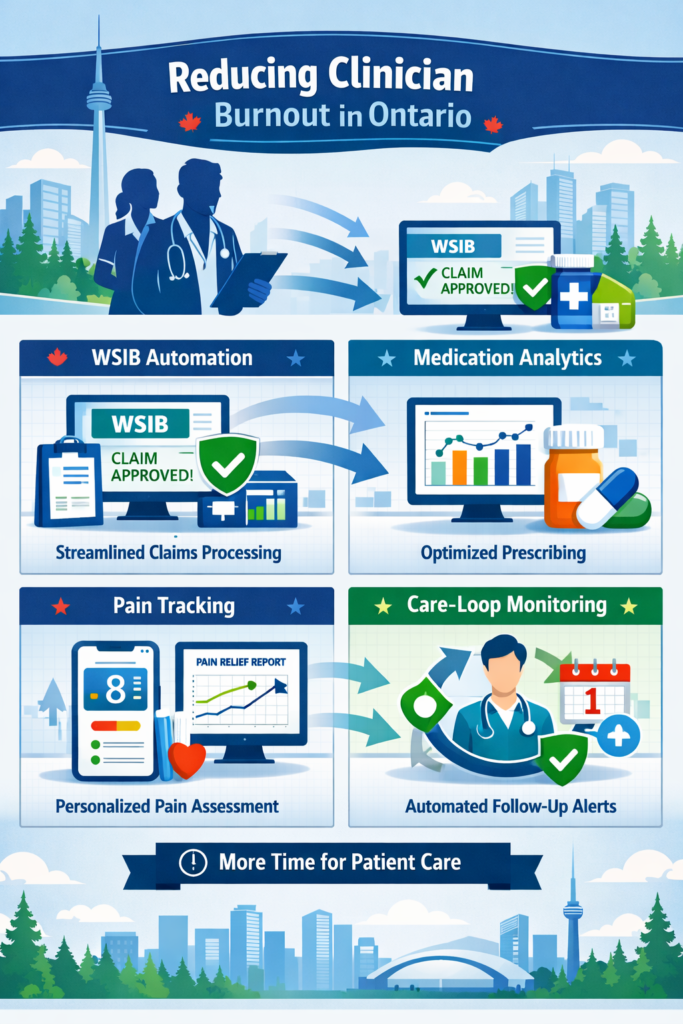
Underlyte’s suite of clinical‑intelligence tools was engineered by consultants with deep experience in Canadian workflows. Each product directly targets a major burnout driver.
1. ClaimAssist Pro — Eliminating Administrative Overload
Administrative friction is one of the top contributors to burnout in Ontario. ClaimAssist Pro reduces this burden by:
- Automating WSIB and insurance workflows
- Reducing repetitive data entry
- Flagging missing documentation before submission
- Cutting down on rejected claims
- Freeing clinicians from non‑clinical paperwork
By streamlining OCF/WSIB processes, ClaimAssist Pro returns hours per week back to physicians and clinic staff — time that can be reinvested into patient care or personal recovery.
2. Rx‑Efficacy Audit — Reducing Cognitive Load in Prescribing
Medication management is a major source of clinician stress, especially when dealing with polypharmacy, chronic pain, or complex patient histories.
Rx‑Efficacy Audit reduces cognitive load by:
- Correlating medication intake with real‑world patient relief
- Surfacing safety flags and adherence issues
- Highlighting ineffective or redundant medications
- Supporting evidence‑based prescribing decisions
This reduces the mental burden of “guess‑and‑check” prescribing and improves patient outcomes.
3. CeaseMyPain — Improving Patient Self‑Reporting & Reducing Follow‑Up Burden
Clinicians often spend significant time interpreting vague or incomplete patient pain descriptions.
CeaseMyPain solves this by:
- Structuring patient‑reported pain data
- Tracking relief patterns over time
- Providing clinicians with clear, actionable insights
- Reducing unnecessary follow‑ups and clarifying triage
Better data means faster decisions — and fewer clinician hours lost to ambiguity.
4. Care Loop Sentinel — Closing Care Gaps Automatically
Follow‑up management is one of the most time‑consuming and error‑prone tasks in Ontario clinics.
Care Loop Sentinel:
- Automates follow‑up reminders
- Tracks recovery, mobility, and adherence
- Flags patients at risk of deterioration
- Reduces manual outreach and tracking
- Supports safer, continuous care
This reduces the emotional and administrative load on clinicians while improving patient safety.
The Combined Impact: A System Designed to Reduce Burnout
Underlyte’s ecosystem reduces burnout across four dimensions:
| Burnout Driver | Underlyte Solution | Impact |
|---|---|---|
| Administrative overload | ClaimAssist Pro | Fewer hours spent on paperwork; reduced errors |
| Cognitive load | Rx‑Efficacy Audit | Clearer prescribing decisions; less mental fatigue |
| Patient communication burden | CeaseMyPain | Structured data; faster triage |
| Care‑coordination stress | Care Loop Sentinel | Automated follow‑ups; fewer missed cases |
This aligns with national findings that burnout prevention saves $3,400 per employee per year, and organizations that invest in preventative systems see burnout drop from 47% to 27% Mental Health Research Canada.
Conclusion: A Healthier Future for Ontario’s Clinicians
Ontario’s healthcare system cannot thrive if its clinicians are exhausted, overwhelmed, and unsupported. Burnout is not inevitable — it is a solvable workflow problem.
Underlyte Health Systems was built to restore:
- Time
- Clarity
- Efficiency
- Clinical confidence
- Human connection in care
By reducing administrative friction, improving data quality, and automating care‑coordination tasks, Underlyte helps clinicians reclaim the bandwidth they need to deliver exceptional care — and to sustain their own well‑being.
Hi, this is a comment.
To get started with moderating, editing, and deleting comments, please visit the Comments screen in the dashboard.
Commenter avatars come from Gravatar.